

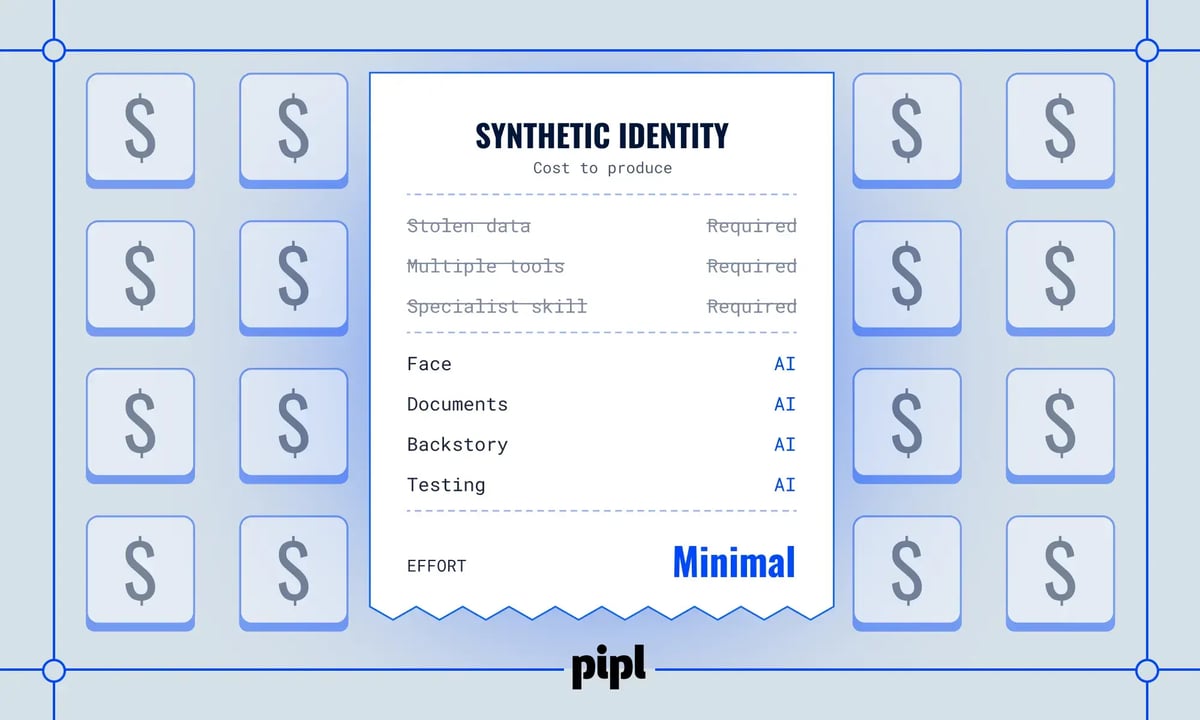


Think of a fraudster building a false identity.
The profile picture? A deepfake generated with AI. A long credit history? Fabricated in minutes. Supporting account records? Pulled by an AI agent from 1,000 simulated profiles.
Your onboarding flow sees a convincing persona and makes a straightforward risk decision. For the fraudster, AI did most of the legwork. That’s the shift behind AI synthetic identity fraud: it has changed the economics of deception.
What is AI synthetic identity fraud?
AI synthetic identity fraud is the use of artificial intelligence to construct or alter false identities for fraudulent gain. AI acts as the generation engine, producing realistic faces, forged documents, and plausible histories that blend real and fabricated data, so fraudsters can create convincing fake personas with far less time, skill, or expense than before.
It differs from classic identity theft in one important way. Identity theft borrows a real person’s identity, and the victim eventually notices. A synthetic identity belongs to no one, so there is often no victim watching their credit report and no complaint to trigger an investigation.
How does AI change the economics of synthetic identity fraud?
AI lowers the cost of every step in building a fake identity, from creating the persona to testing whether it passes. Synthetic identities are nothing new. Fraudsters have spent years fabricating identities from a mix of real and false information, and the Federal Reserve Bank of Boston has warned that generative AI is making this fraud harder to detect.
What AI adds is a more efficient way to manufacture plausibility:
- Lower production costs: What does it take to create a convincing synthetic identity? Traditionally, it meant stolen data, multiple tools, and specialist skill. Now AI can generate faces, alter documents, and write backstories, so each credible synthetic takes far less effort.
- Higher potential volume: How many false personas can one operation produce? Effort used to put a natural ceiling on output. AI turns production into a repeatable process, so fraudsters can create synthetic material at scale.
- Cheaper experimentation: Does the fake identity work? Real-world testing used to carry real risk. AI can iterate and revise offline, which gives fraudsters a far cheaper feedback loop.
- Greater quality per dollar: How accessible are high-quality synthetic personas? AI now handles much of the complex work, and fraud-as-a-service marketplaces sell the remaining ingredients, so even low-skill actors can assemble convincing identity materials.
How does an AI synthetic identity move from creation to cash-out?
A synthetic identity usually follows a 3-stage lifecycle, and AI speeds up each stage.
- Build. The fraudster combines a real identifier, often a government number belonging to someone unlikely to check their records, with an invented name, an AI-generated face, and supporting documents.
- Nurture. The identity applies for small lines of credit, opens accounts, and builds a thin but clean history. AI agents can manage dozens of these personas at once, keeping their activity plausible.
- Bust out. Once credit limits are high enough, the identity maxes out every line and disappears. With no real person attached, the loss often gets written off as a credit default rather than recognized as fraud.
The nurture stage is where detection gets hardest. A patient synthetic can look like a model customer for months.
Why is AI synthetic identity fraud a concern?
AI lowers the cost of credibility. In turn, it raises the cost of establishing trust.
Look at what standards bodies now expect. The final version of NIST’s identity proofing guidelines, SP 800-63A-4, published in July 2025, adds a dedicated section on digital injection attacks and forged media, including deepfakes. It lists 8 safeguards for remote identity proofing:
- Confirm that media comes from a genuine sensor, not a virtual camera, emulator, or jailbroken device
- Analyze all submitted media for signs of modification, manipulation, tampering, or forgery
- Exchange data only over authenticated protected channels
- Use passive means, outside the applicant’s control, to detect forged or manipulated media
- Authenticate capture sensors or use device attestation
- Analyze media for the signatures of known generative AI and deepfake tools
- Train proofing agents to spot manipulated media, such as high latency or synchronization issues
- Add random “human-in-the-loop” cues, such as asking the applicant to move or pass an object in front of their face
Each measure adds a defensive burden. When the usual signals of legitimacy are easy to fabricate, fraud teams have to work far harder to establish trust.
How do you detect an AI synthetic identity?
You detect an AI synthetic identity by testing for evidence that is expensive to fake, not just evidence that looks right. Existing identity verification tools remain the first line of defense, and fraud teams can layer in new controls that build a more reliable picture of each identity.
What makes identity evidence trustworthy?
NIST’s identity proofing guidance points to several qualities that make evidence harder to counterfeit. Synthetic identity detection works best when it weighs all of them together:
- Evidence depth: Look for substance, not just appearance or volume. Deep evidence ties back to the real world. AI can fabricate a bank statement; it has a much harder time matching the internal transaction history a real bank holds.
- Tenure: Look for a credible chronology of activity, not just a history. AI can age accounts, but long-term behavior, continuity, and human activity are much harder to fake. NIST recommends device and account tenure checks for exactly this reason.
- Corroboration: Find attributes that agree across several independent sources. AI can tell a story; confidence comes from separate systems each backing up the same claim, such as a payroll history that matches a tax record.
- Real-world relationships: Look for connections to other people. Genuine identities show up in overlapping contexts, such as workplaces and networks, and real people can vouch for each other. AI might build a résumé, but an employment check with an HR team is much harder to fake.
- Organic behavior: Look at the character of an identity. AI can mimic humans to a startling degree, yet it often lacks the context of a real life. The test isn’t imperfection; it’s whether the identity’s actions make sense for its circumstances.
- Origin: Verify where identity details come from. Synthetic personas often reuse infrastructure, such as devices, networks, and addresses. Data that started at an authoritative source, such as a government agency, is much harder to fake, so trace attributes back to where they were issued.
- Attribute coherence: Check that the pieces of an identity fit together. AI can be internally consistent and still clash with the wider picture of a real person. The goal is to assess whether the details tell a coherent story, not to enforce static rules.
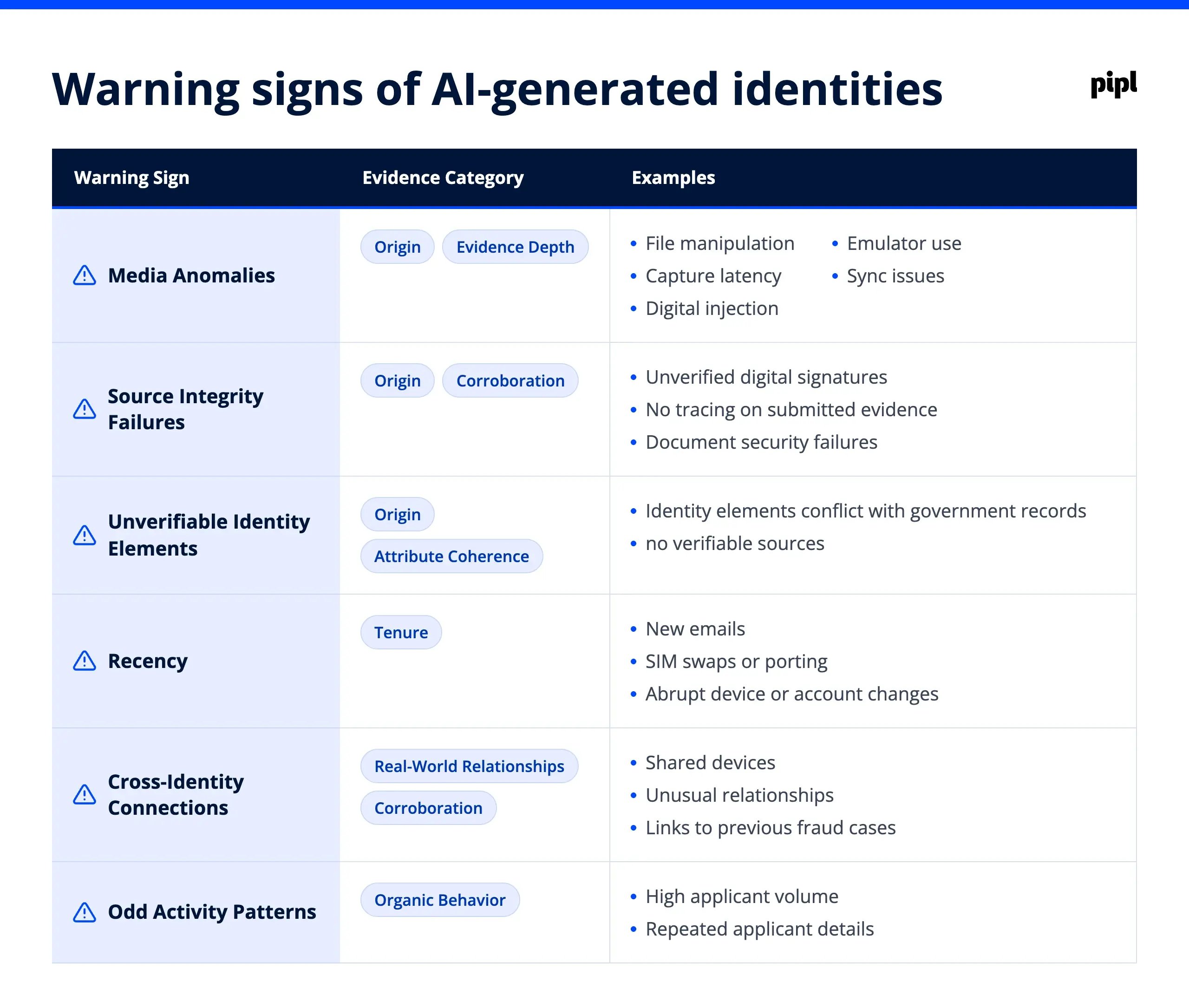
No single sign is proof. A new email address on its own describes plenty of honest customers. A new email, a recently ported phone number, and a device shared with 3 other applicants is a different story.
How do you avoid false positives with thin-file customers?
Judge identities on the depth of their evidence, not on how much history they have. The economics of AI deception affect another group: legitimate customers.
Think of young adults, recent immigrants, or credit-invisible people. They may lack the most obvious signals of trust, and many look superficially similar to AI synthetic identities. Take an overly strict stance toward AI-based attacks and you risk excluding these thin-file customers, along with the revenue they bring. Scoring that draws on broader identity context helps here, especially in thin-file environments where credit data runs out.
False positives show why defense isn’t only about tightening static checks. What matters is evidence depth across the broader identity. NIST makes the same point in its own guidance, which recommends offering trusted referees and applicant references to people who can’t meet the usual evidence requirements. Give genuine customers an appropriate way to establish who they are, even as AI changes our relationship to credibility.
What does agentic AI mean for identity trust?
Agentic AI lets fraud operations run end to end with little human involvement, which turns identity verification into an ongoing question rather than a single checkpoint. INTERPOL’s 2026 Global Financial Fraud Threat Assessment describes the industrialization of fraud, and INTERPOL has called agentic AI a force multiplier because it can plan and execute complete fraud campaigns on its own. It estimates that AI-enhanced fraud is 4.5 times more profitable than traditional methods. The risk is not only what AI can build, but what it can now coordinate.
Imagine an AI agent performing autonomous actions inside your system. Is it a good bot? How do you decide what rights or access to give it? Can you link it to a verified identity?
Monitoring and containment also become more dynamic. Even if an agent is verified at the start, its later actions can still cause harm. AI agents give customers and fraudsters alike a way to act with less human interaction, and fraud teams will need to keep evolving what counts as trustworthy.
How do you prevent AI synthetic identity fraud?
Prevention comes from layered, continuous evaluation of identity evidence rather than a single gate at signup. Every business and sector needs its own mix of defenses, though a few best practices hold up against AI-driven threats:
- Enhance identity depth: Counter AI-generated materials by building a deeper, more complete picture of each identity. Ground trust in verified, independent evidence, such as the history behind a customer’s phone and email signals, not just appearances.
- Share and collaborate: Coordinate across your own applications, data, and fraud intelligence teams. Exchange fraud signals with institutions across the industry, too. Connecting identities reveals patterns that isolated checks miss.
- Treat trust as ongoing: Earn confidence across the entire identity lifecycle, not at a single point in time. Monitor account activity and reassess trust as behavior changes, which matters most during a synthetic’s nurture stage.
- Layer and combine: Layer defenses to close blind spots and detection gaps. Strength comes from coverage that extends beyond what any single check can deliver.
- Learn and evolve: Confirmed fraud outcomes are a chance to improve. Calibrate to your own approval and loss data, learn from your losses, and make controls hard to probe. Scoring calibrated to your actual fraud environment adapts faster than a generic rule set.
Conclusion: the economics of AI fraud defenses
AI makes synthetic identities cheaper to produce, easier to scale, and less expensive to adapt. That raises the cost of confidence and changes what we consider credible.
Deception is only one side of the equation, though. In a KPMG survey of financial institutions, 76% of respondents named fraud detection and prevention as their top application for generative AI.
Entire industries are already exploring how AI can surface contextual meaning, scale analysis, and adapt defense strategies. Elephant, Pipl’s large risk model (LRM), is one example. It’s built on Pipl’s identity graph of 5B+ identities and 20+ years of identity data, evaluates 1,000+ signals per decision, and is calibrated to each customer’s environment. It returns a score and the reasoning behind it in real time, and your own system makes the call. It’s evidence depth, delivered at the speed of a transaction.
The takeaway is a hopeful one: as deception scales, so can your defenses. That’s the hidden opportunity the new economics of AI presents to fraud teams, and it’s why Pipl Trust plugs into your existing risk stack rather than replacing it.
See how Pipl Trust can add identity depth to your fraud decisions. Request a demo with one of our fraud prevention experts.