

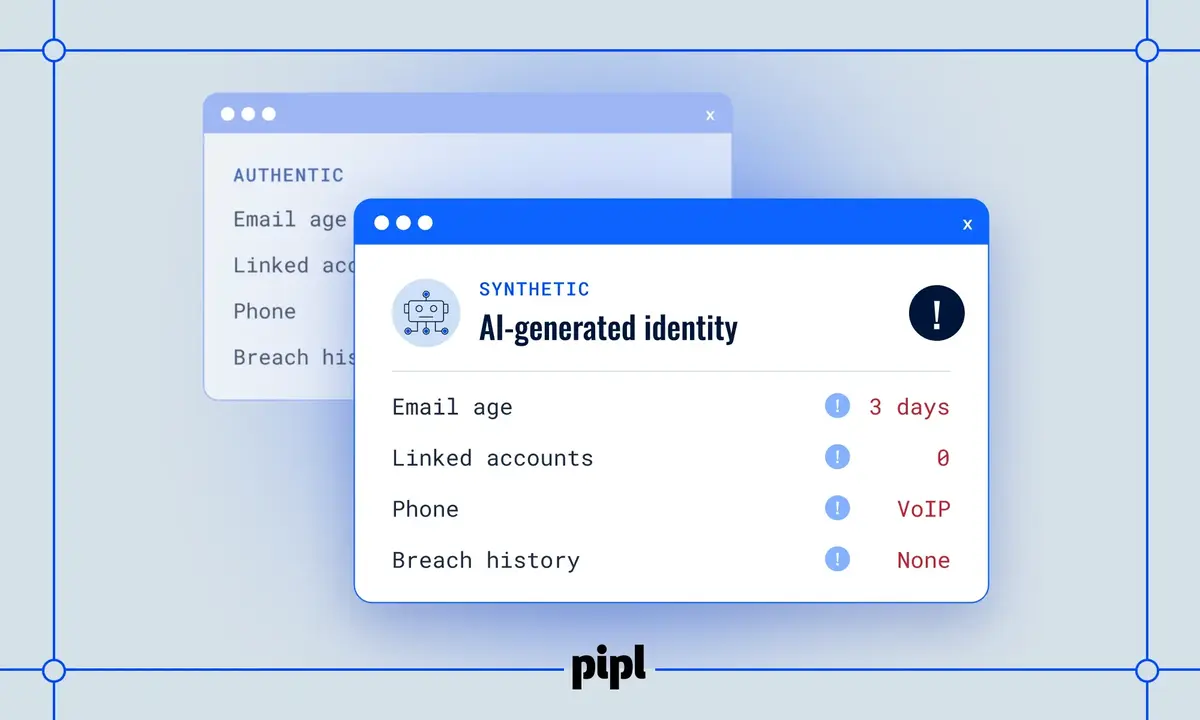


Synthetic identity fraud costs you twice: once when a fabricated customer maxes out a credit line and disappears, and again when tighter onboarding rules turn away the real applicants you wanted. Fraudsters now use generative AI to produce faces, voices, and documents that pass traditional checks, then attach them to partial real data such as a stolen Social Security number or a purchased email address. The result is a “new person” with no fraud history and nothing for a blocklist to catch. Tools built to verify documents or query credit files were designed for a world where the person behind the documents was real, which is why account opening has become the front line. Real people leave something AI can’t easily invent: years of identifiers used together in daily life.
What is synthetic identity fraud?
Synthetic identity fraud is the use of a combination of personal data, real, fabricated, or both, to create a person who doesn’t exist and use that persona to open accounts, borrow money, or move funds. The Federal Reserve’s industry-recommended definition frames it as combining personally identifiable information to fabricate a person or entity for dishonest gain.
It differs from traditional identity theft in one important way. In identity theft, a real victim exists and usually notices. In synthetic identity fraud, the “victim” is often a fabricated person, so no one calls to complain. The Federal Reserve’s payments team describes synthetic identity fraud as reported to be the fastest-growing type of financial crime in the United States, with losses in the billions each year. Many cases are only discovered after a “bust-out,” when the persona draws down every available line of credit and vanishes, and some lenders still book those losses as ordinary credit defaults.
Why does synthetic identity fraud defeat traditional verification?
Traditional verification checks whether individual artifacts look real. Synthetic identities are built from artifacts that look real, or are real, so each check passes on its own terms. The 3 most common defenses each fail for a different reason.
Document checks and liveness detection
Document-based verification asks whether an ID looks authentic and whether a live face matches it. Generative AI has made both questions easier to fool. The U.S. Treasury’s Financial Crimes Enforcement Network (FinCEN) issued an alert on deepfake media in fraud schemes after seeing a rise in suspicious activity reports describing AI-altered identity documents used to get past verification and authentication. Some documents in these schemes are genuine and stolen; the face paired with them is generated.
Liveness detection raises the cost of an attack, and it still matters. Its weakness is scope: it evaluates a single moment, in isolation, against an adversary who can now generate convincing images and video on demand. A team that relies only on document scans and selfies is defending against yesterday’s tools.
Credit bureaus and knowledge-based authentication
Knowledge-based authentication (KBA) asks questions like “Which of these streets have you lived on?” That works against an imposter who stole someone else’s data. Against a synthetic identity, the fraudster often authored the history the questions are drawn from. Many synthetic personas are deliberately “nurtured” for months or years, building a thin credit file through small accounts and authorized-user piggybacking, so the bureau record exists precisely because the fraudster created it. When the bust-out finally comes, the persona is abandoned and the operator moves on to the next one.
Behavioral analytics at fraud-ring scale
Behavioral tools, which look at typing cadence, navigation, and device patterns, are harder to game than documents. Organized rings compensate with scale. An operator running hundreds of synthetic identities can rotate devices and vary behavior across accounts, so no single account looks anomalous. Anomaly detection assumes fraudsters are rare outliers, and coordinated rings are built to look like the middle of the distribution. Device fingerprinting alone has similar limits when it isn’t tied back to identity.
Why 20+ years of digital history is hard to fabricate
Authentic digital history is hard to fake because it’s relational and cumulative: it requires many independent identifiers to have existed for years and to have been used together the whole time. A single aged email address can be bought. A coherent decade of that email appearing alongside the same phone number, the same home addresses, and the same name across unrelated services can’t be bought off the shelf.
Pipl’s identity graph spans 5B+ identities across 150+ countries, built on 20+ years of identity data and refreshed by 2B+ daily signal updates. Elephant, Pipl’s large risk model, evaluates how identity, behavioral, and device signals relate to each other rather than only whether they’re present. For a synthetic identity to look established in that context, it would need email accounts that have been active for years, phone numbers assigned long before the application, address history that lines up with both, and all of it pointing to the same person.
Consider the checkpoints a synthetic identity must clear: email age, the connections between email, phone, and address, breach exposure history, social presence, and how many other identities share each element. Each one is a separate source of evidence. Copying a legitimate person’s email doesn’t help, since that email already belongs to someone else in the graph. Buying aged social or email accounts helps with 1 checkpoint and does nothing for the others. An identity that pairs a 2015 email with a phone first seen last month and an address first seen last quarter shows a broken timeline that real people rarely produce.
How connectivity exposes synthetic identities
Connectivity measures how strongly an email, phone number, address, and name link together in real-world use. For legitimate people, these links are strong and consistent. Your primary email is tied to your phone for account recovery and 2-factor authentication. Your email is tied to your address through shipping and account registrations. Your phone is tied to your address through utility and service records. Those connections formed organically, over years, because you actually used these identifiers together.
Synthetic identities show fractured connectivity because they’re assembled from unrelated sources. A fraudster might buy a breached email (linked to someone else’s history), add a disposable phone number (linked to nothing), and use a rented mail drop (linked to dozens of other accounts). Run through a scoring layer such as Pipl Elements, which delivers phone and email intelligence into existing rules and models, each element comes back isolated: the email doesn’t match the phone, the email doesn’t match the address, and the phone has no history at that address at all.
Connectivity is difficult to fake at scale for a simple economic reason. A well-funded ring might register real email accounts or obtain real phone numbers. Making those elements show up together in legitimate activity, month after month, requires effectively living as that person. Doing that for 100 identities in parallel costs more than most attacks return, which is why many synthetic identities fail on connectivity rather than on any single attribute.
How volatility signals detect fraud rings
Volatility measures how many distinct identities a single email, phone number, or address has been linked to, and how quickly that number grows. Low volatility is normal. High volatility over a short window is one of the clearest signs of shared fraud infrastructure.
Picture a ring hitting a lender with 500 account applications a day. Each application uses a slightly different email, but several share a phone number or an address, because unique infrastructure for every persona is expensive. Viewed together, the pattern is obvious: an email tied to 15 different people at different addresses, an address linked to 50 emails in 90 days, a phone number shared across 20 accounts. That isn’t a household; it’s a ring’s operating equipment.
Real people do reuse identifiers. You might have a secondary email for newsletters or a work phone registered at home. The volatility stays low, typically a handful of linked identities that grows slowly. Growth rate is what separates the 2 cases. A phone number linked to 2 new identities a year for 10 years reflects organic life. A phone number linked to 2 new identities a week is an attack.
Since volatility is measured across the whole graph, a ring’s shared infrastructure starts to stand out as soon as it’s reused at volume. The ring then faces a choice: pay for unique infrastructure for every persona, which makes the attack less profitable, or accept volatility signals that expose its coordination. Fraud investigation teams can use the same links to map the rings and synthetic clusters behind a case instead of working each account alone.
Breach exposure: the timeline authentic identities leave
Breach exposure history shows when an identifier first appeared in known data breaches, and that timeline is strong evidence of age. A legitimate person might show up in breaches from 2010, 2015, and 2019, because the same email address was exposed in several leaks over a decade. That pattern is unflattering but authentic.
Fraudsters often prefer breached emails, since an exposed address won’t trip a “brand-new email” rule, and stolen credentials are cheap on dark web markets. The tactic creates a temporal mismatch, though. The email carries a 2015 breach record, while the phone it’s paired with first appeared in 2024 and the address in 2023. The email lends surface legitimacy; the timeline around it tells the real story of a recently assembled identity.
That coherence check is what Pipl Trust returns as a Trust Score on a 0–1,000 scale, with the signals and reason codes behind it, so your team can see why a profile scored the way it did.
Social presence as evidence of a lived identity
The number of social and online service accounts linked to an email or phone is another independent signal. A working professional might have a LinkedIn profile, a personal social account, a GitHub account, and an X account. Each one implies years of activity that fraud rings find tedious to fake.
Fraud rings can generate profiles, and some buy aged accounts outright. Producing thousands of profiles with genuine history, real connections, and believable engagement is a different matter, so most synthetic identities either have no linked accounts or have accounts that are new and thin. The gap between a claimed identity and actual presence is often telling: a self-described software engineer with no developer footprint, or a business owner with no professional profile anywhere.
Social presence works best as supporting evidence rather than a gate. Plenty of real people avoid social media, so its absence alone shouldn’t sink an application. Its value is in corroborating, or failing to corroborate, the rest of the profile.
How to detect synthetic identity fraud: a layered defense
Detecting synthetic identity fraud takes layers, because fraudsters adapt to any single control. The Federal Reserve’s synthetic identity fraud mitigation toolkit makes the same point: no single tool closes the gap. A practical sequence looks like this:
- Score at signup, where synthetic identities enter. Account creation is the cheapest place to stop a synthetic identity. Calibrate Trust Score thresholds to your own labeled outcomes. As an illustrative starting point on the 0–1,000 scale, teams might auto-approve signups at 750+, send 400–749 to manual review, and decline or add friction below 400.
- Add explicit synthetic identity checks. Require an email older than 180 days for new accounts, at least 2 connected identity elements (email and phone matching, or email and address matching), and a flag on any element linked to 10+ identities. Route the rare legitimate exception, such as someone who just changed email providers, to a phone verification fallback rather than an outright decline.
- Watch your own traffic for ring infrastructure. If 20 declined applications share a phone number in a week, or the same address appears in 30 attempts in a month, treat that phone or address as ring infrastructure and send every future application that uses it to review or decline.
- Feed outcomes back into the model. Confirmed fraud and confirmed good customers are the labels that keep scoring calibrated. Teams that build a fraud feedback loop catch drift and new ring patterns faster than teams that only tune rules.
- Keep watching after onboarding. Some synthetic identities are nurtured quietly for months before a bust-out. Account protection checks on logins, profile changes, and new devices can flag when an established account suddenly links to known ring infrastructure.
Red flags of a synthetic identity
These warning signs rarely prove fraud alone, but together they describe the typical synthetic profile:
- An email address that is only days or weeks old, or old but never linked to the applicant’s phone or address.
- A phone number or address first seen recently, paired with an email that has a much older breach history.
- An email, phone, or address shared with many unrelated identities, especially when that count jumped recently.
- No linked social or online accounts, or only accounts created around the time of the application.
- A credit file that is thin, recent, or built through authorized-user piggybacking.
- Documents and selfies that pass inspection while every other identifier lacks history.
How the Trust Network strengthens synthetic identity detection
The Trust Network is the ecosystem of Pipl Trust customers whose aggregated insights, never raw customer data, feed Elephant’s calibration. When rings reuse emails, phone numbers, addresses, IP addresses, or devices across many targets, the patterns that infrastructure creates, such as volatility spikes and rapid growth in linked identities, become visible to the model across the network rather than only inside one company’s traffic.
Over time, the model learns from what is confirmed as fraud. Registration patterns that keep turning up in ring activity carry more risk in new evaluations. Address combinations that looked clean on day 1 but correlate with fraud by day 90 shift the model’s view. For you, the practical effect is that you don’t have to absorb the first wave of an attack alone to recognize it.
From a fraudster’s perspective, the economics get worse with every reuse. Infrastructure that has already been exposed carries risk signals elsewhere, so the only way to keep going is to build fresh, unique infrastructure for every persona. That cost is what makes synthetic identity fraud at scale hard to sustain.
Why deepfakes don’t change the math
Generative AI keeps improving at making individual artifacts look real: faces, documents, voices, and text. Those artifacts are judged in isolation. Evaluated against years of connected identity history, they don’t hold up. A flawless generated face paired with an email that has no history fails. A convincing deepfake liveness video paired with a phone number activated last week fails. Real documents attached to a person with no digital footprint fail.
The asymmetry is durable. Fraudsters can spend more on generation tools, but they can’t easily buy the past. Rewriting years of email activity, social history, and phone and address records that predate the application would mean compromising or controlling long-established infrastructure at scale, which is expensive and slow. As the identity graph keeps growing, every new attempt is measured against a larger base of authentic history.
Identity proofing standards are moving in the same direction. NIST’s updated digital identity guidelines for identity proofing treat identity resolution and identity verification as distinct steps, a recognition that a document passing inspection is only part of establishing that a real person stands behind it. Deepfakes are artifacts without history. Give them 20 years of real, connected activity, and the calculation changes.
Key takeaways
- Synthetic identities beat document-only verification because AI can now produce convincing documents, faces, and video; years of connected digital history remain far harder to fake.
- Connectivity gaps, such as an email never used with the phone or an address never used with the email, reveal fabricated personas quickly, since those elements interweave naturally for real people.
- Volatility spikes expose fraud rings, because coordinating many synthetic identities forces rings to reuse emails, phone numbers, and addresses across unrelated names.
- The Trust Network turns fraud patterns seen across many companies into aggregated insight, so exposed ring infrastructure carries risk signals wherever it’s reused.
See how Pipl Trust scores synthetic identity risk at signup. Request a demo.
Frequently asked questions
What is the difference between synthetic identity fraud and identity theft?
Identity theft uses a real person’s complete identity, so a real victim usually notices and reports it. Synthetic identity fraud blends real and invented data into a new persona that doesn’t belong to anyone. With no single victim watching the account, it can go undetected for months or years until a bust-out.
How do you detect synthetic identity fraud?
Look past whether each artifact is valid and ask whether the identity hangs together over time. The strongest signals are email age, how well email, phone, and address connect, breach exposure timelines, and how many other identities share each element. Combining those signals into a single score at signup catches far more than document checks alone.
Can deepfakes pass identity verification?
Yes, in some cases. FinCEN has warned financial institutions about AI-altered identity documents and deepfake media being used to get past verification and authentication. Pairing document and liveness checks with identity history makes those passes far less useful, since a generated face can’t supply years of linked activity.
Why is synthetic identity fraud so hard to catch?
Synthetic identities are built to pass the checks institutions already run, often with real data mixed in, and some are nurtured for long periods before they’re used. Losses frequently surface as credit defaults rather than fraud, so the problem is undercounted. Detection improves when teams evaluate relationships between identifiers instead of each identifier alone.
Will digital history checks decline real customers with thin files?
They can if used as a hard gate, which is why the score should weigh many signals together and route edge cases to review or step-up verification. A young adult or a recent arrival may have a short credit file yet still show an established email linked to a consistent phone and address. Calibrating thresholds to your own outcomes keeps good customers from paying for the fraud controls.