

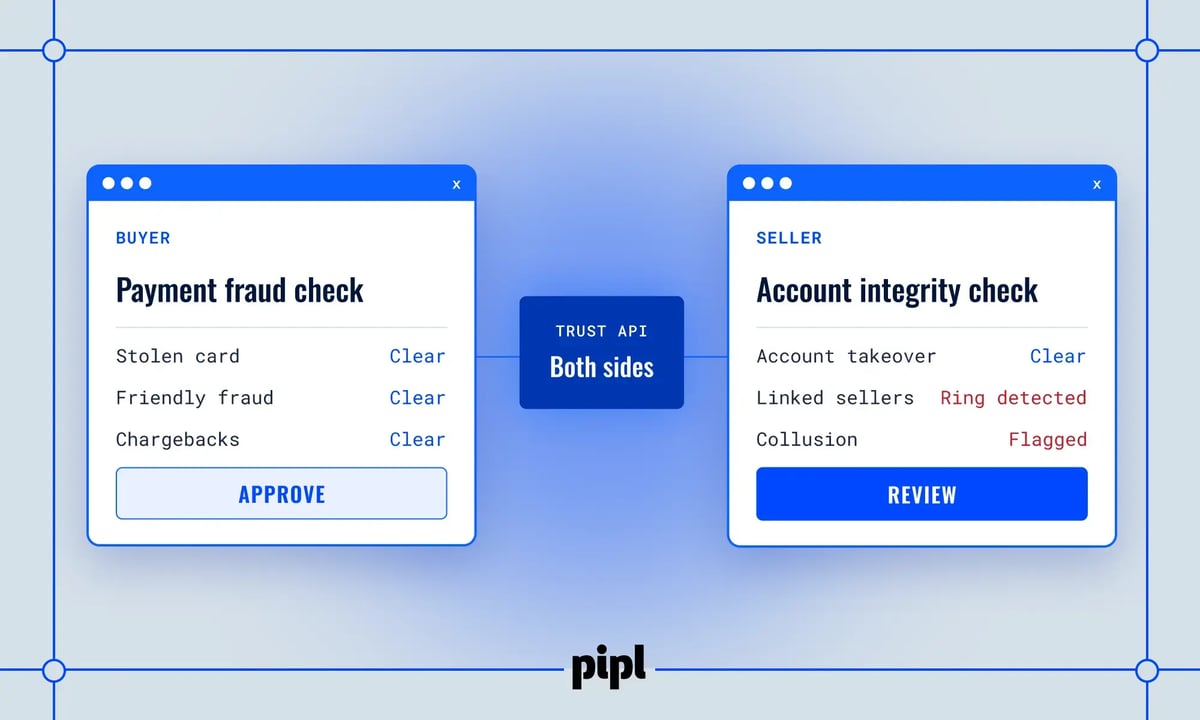


The moment a marketplace goes live, it attracts 2 waves of fraud: buyer-side payment fraud (stolen cards, chargebacks, and friendly fraud) and seller-side abuse (hijacked seller accounts and fraud rings posing as many independent sellers). Effective marketplace fraud prevention has to cover both sides at once. A buyer who passes identity checks can still file a false dispute, and a seller with years of clean sales can still have their account taken over. This guide walks through how Pipl Trust API scores buyers and sellers in the same framework, so your fraud defense protects the platform and the legitimate users on both sides of it.
What is marketplace fraud prevention?
Marketplace fraud prevention is the set of identity checks, risk scores, and policies a two-sided platform uses to stop fraud by buyers, by sellers, and by both acting together. It covers buyer checkout, seller onboarding, seller logins, and payouts, because each is a separate point where a fraudster can enter or cash out.
A traditional retailer only has to worry about the person paying. A marketplace sits between 2 parties with different incentives. Buyers want to buy with as little friction as possible, and sellers want to reach as many buyers as possible with as little verification as possible. Fraudsters exploit both: on the buyer side with stolen payment details or stolen identities, and on the seller side with fake storefronts that list counterfeit goods, harvest payment data, or move illicit funds.
Why is two-sided marketplace fraud so hard to stop?
Two-sided marketplace fraud is hard to stop because the most damaging schemes cross from one side to the other, and tools that score buyers and sellers as isolated events can’t see the connection.
Consider a ring that creates 50 fake seller accounts listing counterfeit goods at premium prices. The same ring creates 50 buyer accounts that purchase from those sellers, inflating sales volume and reviews. Money flows through the marketplace’s payment system, the ring withdraws what it can, and the platform is left holding the chargebacks and the regulatory exposure. Each account looks ordinary on its own; the pattern only shows up when the identity signals connect.
The damage also compounds through the network. A single compromised seller can hurt the platform’s reputation with counterfeit listings, a single compromised buyer can trigger a cascade of chargebacks, and a coordinated ring can distort rankings, reviews, and pricing across categories. That erodes user trust more slowly than direct payment fraud, though more permanently.
The broader fraud environment isn’t easing, either. The FTC reported that consumers lost $15.9 billion to fraud in 2025, up from over $12 billion the year before, across 3 million fraud reports. Regulators have also made seller identity the marketplace’s responsibility: under the INFORM Consumers Act, U.S. online marketplaces must collect and verify bank account, contact, and tax ID information from high-volume third-party sellers.
How do you verify buyers without killing conversion?
Score every purchase with the identity details you already collect, then let the order value decide how much risk you accept. On the buyer side you face 2 different problems: payment fraud and friendly fraud.
Payment fraud signals
For payment fraud, send Trust API the buyer’s name, email, phone, billing and shipping addresses, and IP address at checkout. The response includes a Trust Score from 0 to 1,000, reason codes, attribute scores for email, phone, address, and IP, and the trust signals behind them. Those signals include email age, breach exposure, disposable domains, velocity, and VPN or proxy use. A buyer with a brand-new email, a burst of recent transactions, and a shipping address at a freight forwarder is running a familiar playbook: create the account quickly, buy quickly, then reverse the payment.
Friendly fraud signals
Friendly fraud is subtler, since the buyer is often a real, established person with an aged email, strong connectivity between their details, and a consistent location history. Under Visa’s dispute management guidelines for merchants, cardholders generally have up to 120 days to file most disputes, so friendly fraud can surface weeks after the goods arrive. Identity tells you the buyer is real; behavior tells you whether the dispute is. A buyer who contacts you for a refund through your own process is lower risk than one who skips it entirely and goes straight to their card issuer weeks after delivery. Combine Trust API’s identity signals with that dispute behavior and with your own order history.
Key insight: Don’t block every new buyer. A minimum email age or connectivity requirement will turn away legitimate international buyers and people who created an email specifically for your platform. Use the score to calibrate instead. A new buyer with a high Trust Score and a clean device profile (no emulator, rooted device, or automation) can proceed with standard chargeback protection. A new buyer with a low score, VPN use, and high velocity goes to step-up verification or a lower transaction limit.
How should seller verification work at onboarding?
Seller verification should confirm 2 things: that the applicant is a real, consistent identity, and that the business behind the storefront is legitimate. That makes it harder than buyer verification, and it’s where the account opening decision carries the most weight on a marketplace.
When someone applies to sell, score the application with their email, phone, business address, and personal address where relevant. A legitimate seller typically shows an email that has existed for years and strong connectivity between their email, phone, and address. Their phone is usually a mobile or landline number with a long-standing single owner rather than a VoIP line, and their address is residential or commercial rather than a freight forwarder. Their details usually trace back to professional profiles and activity on other platforms.
A seller whose details don’t share a real history is a different story. Fabricated and synthetic identities mix details from different people, which is why thin connectivity at onboarding matters. Our post on stopping synthetic identity fraud with digital history covers that pattern in depth. Pair the identity score with your know-your-business checks, including the bank account and tax ID collection that the INFORM Consumers Act requires for high-volume sellers in the U.S.
How do you stop seller account takeover?
Score every seller login, not just the application. Account takeover on the seller side looks different from onboarding fraud: the attacker has the seller’s real credentials, so the identity looks clean, with an old email and strong connectivity. The risk shows up in the login context instead.
Send the login event to Trust API with the seller’s account details and the device and IP attempting access. Some logins break the seller’s usual pattern: a new country, an IP the seller has never used, or automation or emulator indicators on the device. Those logins earn a lower score, and that’s your trigger for step-up verification, such as an email confirmation or a one-time code. For high-value seller accounts, consider stronger factors than SMS. NIST SP 800-63B-4 calls for applications at its second assurance level to offer a phishing-resistant authentication option. The account protection use case goes further, covering profile changes, payout account updates, and dormant reactivations, which are the moments a takeover usually pays off.
How do you detect coordinated fraud rings and seller collusion?
Look for shared infrastructure. Fraud rings reuse phones, addresses, IP ranges, devices, and payout accounts, because building fully independent identities at scale is expensive.
Score every seller application, then compare the results across applications. Suppose 15 new applicants all show unusually weak connectivity, as if they’re coordinated throwaway identities, and all route through the same IP range. You’ve likely found a ring. Build a graph of your sellers linked by shared IP address, payment method, shipping address, and phone number. When 10 or more sellers cluster on the same node, send them to manual investigation.
Context still matters, since sharing isn’t always collusion:
- Payout accounts. 2 sellers paid out to the same bank account should both be investigated.
- Addresses. 2 legitimate sellers can share a business incubator or co-working space. 50 sellers at one address who all created listings within 2 hours of each other are a ring; 2 sellers at one address who listed 6 months apart with no interaction are probably just neighbors.
- Phone numbers. Spouses running a family business may share a number. When a phone with many past owners suddenly appears on 10 seller accounts, that’s a coordination indicator. Check whether those sellers list similar goods, price identically, and ship from the same place. If all 3 are true, you’ve found a ring.
As your marketplace grows, sellers also learn to game it with duplicate accounts that dodge listing limits, coordinated promotions, and inflated ratings. Running the same linkage check whenever a seller logs in or changes account details catches these duplicates before they compound.
How do cross-platform signals strengthen marketplace fraud prevention?
Cross-platform signals let you see an identity’s history beyond your own platform. Trust API evaluates 1,000+ signals against an identity graph of 5B+ identities across 150+ countries. An email address a fraudster creates for your marketplace may already carry history elsewhere: recent breach exposure, no meaningful online footprint, and a very short life. Those are the hallmarks of a throwaway account, and they’re visible on the first transaction.
The same graph helps with repeat offenders. A seller banned for counterfeits who reapplies a month later under a new name is often invisible to platform-only rules. If they reuse a phone number, address, or payout method, the identity graph can connect the new application to the identity behind the old one. That gives your rules what they need to match it to your ban list or route it to review.
The network effect also runs the other way. Elephant, Pipl’s large risk model, keeps learning from fraud seen across the Trust Network, which shares aggregated insights, never raw data. When you report outcomes, including a coordinated ring you uncovered, that feedback sharpens your own calibration and contributes to what Elephant learns.
How should Trust Score thresholds differ for buyers and sellers?
Buyers and sellers need different thresholds because the cost of a mistake is different. A false decline on a $30 order loses a sale; approving a fraudulent seller can expose every buyer who visits their storefront. Trust API maps the score to approve, review, or decline at thresholds you set, so the numbers below are illustrative starting points to calibrate against your own outcome data.
For buyers, slide the threshold with order value to keep approval rates high where risk is low:
- Orders under $50 from new buyers (email under 3 months old): approve above 500.
- Orders from $50 to $500: approve above 650.
- Orders over $500: approve above 800, or step up with SMS or address confirmation.
For sellers at onboarding, set the bar higher, because sellers carry the platform’s reputation:
- 750 and above: approve, once your required business verification is complete.
- 650 to 749: borderline. Require phone and address verification and route to manual review.
- Below 650: require document upload (government ID and business records) and manual review before approval.
For seller logins, use the score from the login event itself. A seller with a strong onboarding history who logs in with a score above 600 continues without friction. Between 400 and 600, confirm with a one-time code by email or SMS. Below 400, require full re-authentication before the session can change payout details or listings. A login over Tor, with automation detected, from a new country is a typical example.
How do you protect payments and payouts?
Score both directions of money movement. At checkout you want fast approval with low chargeback exposure. At payout you want sellers paid quickly without turning your platform into a laundering channel. The transaction risk decision covers the buyer side, and payout holds cover the seller side.
- Buyer payments. Score the purchase with the buyer’s email, the amount, and the billing and shipping addresses. Run your internal rules at the same time. Is the shipping address a known problem for this product category? Is the buyer’s recent transaction count 3 times their norm? Is the order 10 times their usual value? If the score is above 800 and the rules pass, approve immediately. If the score is between 650 and 800 and one rule flags, such as a freight forwarder address, require address confirmation or a delivery signature.
- Seller payouts. Score the session when a seller requests a payout, then apply a hold based on seller risk. A seller with a score above 800, an account older than 6 months, and zero chargebacks gets paid within 24 hours. Every other seller in good standing goes on a 7-day hold: the payout is approved, but funds are released after 7 days. That gives you time to see whether the related buyer transactions come back as chargebacks. Sellers below 650 go to manual review before any payout. A hold is less friction than a full review and still gives you a fraud buffer.
When should borderline cases go to manual review?
Send borderline cases to a person, not a rule. For sellers, that’s typically the 650 to 749 band. Pipl Trust Insights gives reviewers one view of whether the email, phone, address, IP, and device connect to one real person, and the decision stays with your team.
For a borderline seller, the reviewer asks 3 questions:
- Is the identity real or fabricated? Real sellers show strong connectivity to professional profiles and past ecommerce activity. Fabricated sellers show weak connectivity, a sparse online presence, and recent registration.
- Is there a prior fraud association? The identity graph may link the seller’s address or phone to past counterfeit activity.
- Does the seller’s behavior match the identity? A seller claiming to be a leather goods manufacturer with no professional background in the trade deserves a closer look.
Give reviewers your marketplace context next to the identity view: average rating, return rate, complaints, average order value, and listing categories. Take a seller with a score of 700 and weak connectivity but 300 successful sales, a 4.8-star rating, and zero chargebacks. That seller is probably a legitimate new online seller with a limited digital footprint. A seller with the same score, zero sales, and listing photos that match known counterfeit imagery probably isn’t.
How do you improve seller screening over time?
Close the loop with outcomes. After thousands of transactions and onboardings, you have labeled data: sellers you approved, sellers you rejected, and what happened next (stayed legitimate, banned for fraud, or flagged for counterfeits). Feeding those outcomes back to Pipl calibrates Trust Scores to your marketplace rather than a generic baseline.
Use the same data to audit your own thresholds each quarter. Of the sellers you approved between 700 and 750, what share were banned for fraud within 90 days? Of those you rejected between 500 and 600, how many would have been legitimate? The answers tell you whether your thresholds are too conservative, costing you good sellers, or too lenient, letting fraud through. Adjust based on actual outcomes, and watch for the cost of over-correction. Our post on false declines and stale signals explains why a system that can’t learn from its own decisions keeps paying for them.
Marketplace fraud prevention checklist
- Score buyers at checkout with a threshold that slides by order value.
- Score sellers at onboarding, at every login, at account changes, and at payout.
- Collect and verify bank account, contact, and tax ID details for high-volume sellers.
- Graph sellers by shared IP, phone, address, device, and payout account, and review clusters of 10 or more.
- Treat a dispute filed without a refund request as a stronger friendly fraud signal than the refund request itself.
- Hold payouts for new and mid-risk sellers long enough to see chargebacks land.
- Send borderline sellers to manual review with marketplace context beside the identity view.
- Report outcomes back and re-check thresholds every quarter.
Ready to protect both sides of your marketplace? Request a demo to see how Pipl Trust API scores buyers and sellers with your own data.