

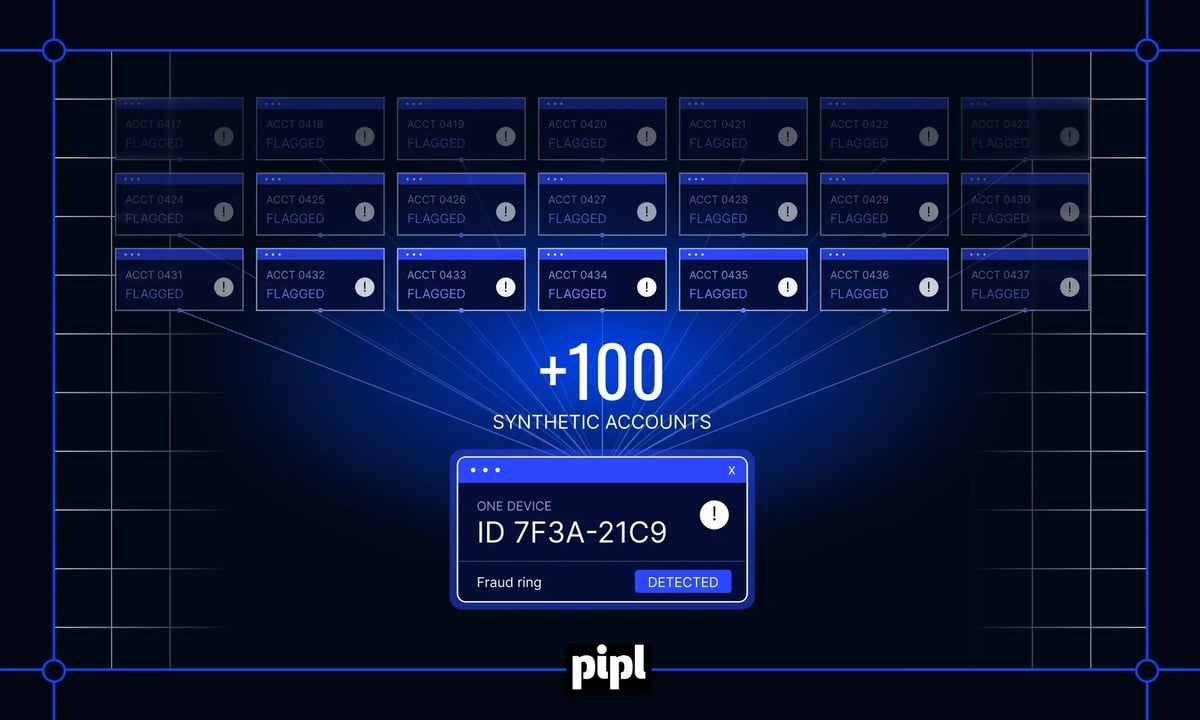


Every fraud loss starts as a decision that looked reasonable at the time: an applicant who passed verification, a login that matched the device on file, a transfer that stayed under every threshold. The identity fraud trends shaping 2026 are defined by that problem. Attackers have stopped trying to beat your checks head-on. They build identities, accounts, and money flows that pass each check individually and reveal themselves only as a pattern.
These aren’t incremental changes to familiar fraud types. They’re structural shifts in how attackers operate, and they reward defenses built for how fraud works now rather than how it worked a few years ago. This guide covers what’s emerging, what each threat looks like in practice, how teams are responding, and what to expect in 2027. For a deeper look at the first threat on the list, see our guide to stopping synthetic identity fraud with digital history.
What is identity fraud, and how is it changing?
Identity fraud is the use of stolen, fabricated, or manipulated personal information to open accounts, take over existing ones, move money, or obtain credit under a false identity. It’s changing from high-volume attacks on single accounts toward coordinated schemes where many accounts, devices, and identities work together, each designed to pass standard verification.
That shift matters because most fraud controls still score events 1 at a time. A rule or model asks whether this applicant, this login, or this payment looks risky. The newer attacks are engineered to answer “no” to that question. The risk lives in the relationships: the device shared by 40 applicants, the address that appears on 12 accounts opened in the same week, the phone number with no history before last month. Seeing those relationships requires identity data that connects records across sources and time, not just a snapshot of the record in front of you.
Fraud tooling has also become a commodity. Stolen identity data, account-creation scripts, and document-spoofing tools are sold as packaged services, which lowers the skill needed to run a coordinated attack. Our post on the dark web and the rise of fraud-as-a-service covers how that market works.
Synthetic identity fraud: still the leading identity fraud trend
Synthetic identity fraud tops most lists of identity fraud trends because it’s hard to detect and expensive when it matures. The Federal Reserve notes that synthetic identity fraud is reported to be the fastest-growing type of financial crime in the United States. It also convened an industry focus group to agree on a common definition of synthetic identity fraud so organizations could measure it consistently.
Rather than stealing a single person’s identity outright, fraudsters assemble a new one. They might combine a real Social Security number from a single person with a name, date of birth, and address that belong to no one, or stitch together elements stolen from several people. The individual elements are real, so each one checks out on its own. Traditional fraud detection looks for individual risk signals, and a synthetic identity is built to present very few.
The threat is acute for fintech and lending platforms. A single synthetic identity might score as moderate risk: a fairly new account, limited history, nothing alarming. When 100 synthetic accounts share the same construction pattern, the same devices, and the same timing, then build credit and default together, the losses compound. Scoring each application separately misses that coordination.
What a synthetic identity can’t easily fake is a past. A real person accumulates years of connected history: an email used across services, a phone number tied to the same name, addresses that change in a plausible sequence. A fabricated identity tends to show a fresh email, phone, and device with no real history behind them. Pipl’s account opening approach is built on that gap, scoring identity signals in combination to find what’s missing.
Detection works best in 2 layers. At the individual level, Pipl Search resolves an applicant’s email, phone, and address against an identity graph built over 20+ years, so you can see whether those attributes connect to a consistent person. At the network level, Trust Insights shows connections between accounts, so 50 synthetic identities created by the same operator surface as a cluster linked by shared devices, IP addresses, and account-creation timing.
How are deepfakes changing account takeover?
Deepfakes let attackers defeat checks that rely on a face, a voice, or a document image. FinCEN has reported a rise in suspicious activity reports involving deepfake media, particularly fraudulent identity documents used to get past identity verification and authentication.
The practical effect is that biometric verification alone is no longer enough. A synthesized face can pass a video check today, and generative tools keep improving. What a deepfake can’t do is replicate 20 years of digital history. A synthesized identity might clear a liveness test while still lacking a consistent record of addresses, linked accounts, and phone and email use over time.
That’s why multi-factor verification is converging on 3 layers: biometrics from a specialist provider, behavioral and device analysis, and digital history. Pipl supplies the last 2. Search adds identity history, while Pipl Trust adds device and behavioral context through Trust Device and real-time scoring through the Trust API. A deepfake that fools a camera still has to explain why its identity has no past and why its device behaves like 30 other new accounts.
Why are cross-border fraud rings so hard to detect?
Cross-border rings are hard to detect because no single institution, country, or payment channel sees the whole scheme. Each piece looks legitimate locally, and the coordinated pattern only appears when the pieces are connected.
A modern ring might recruit money mules in the US to receive and forward stolen funds, route traffic through VPN endpoints in Southeast Asia to obscure device location, open accounts in Eastern Europe, and coordinate over encrypted messaging. Fraudsters also practice regulatory arbitrage. They learn which markets have weaker identity verification and which channels are less monitored, then move quickly before a pattern is recognized.
Global coverage matters here. Pipl’s identity graph spans 5B+ identities across 150+ countries, so a real applicant in a new market can resolve on day 1, while an identity with no footprint anywhere stands out. Shared intelligence matters too. The Trust Network is the ecosystem of Trust customers whose aggregated insights, never raw data, feed Elephant’s calibration, and it updates 2B+ times per day. When a pattern spanning accounts in the UK, Germany, and the US shows up in a single customer environment, that learning improves detection for others.
How do money mule networks hide laundered funds?
Money mule networks hide laundered funds by spreading them across many accounts in small, fast transactions that each stay below alert thresholds. The FBI describes money mules as people who move illegally obtained money between accounts on behalf of others, often across countries, adding layers of distance between victims and criminals.
Modern laundering rarely moves large sums at once, since that triggers threshold alerts. Launderers use smurfing (splitting funds across many people) and structuring (keeping each deposit or transfer under reporting limits), combined with rapid movement between accounts. Transaction monitoring catches individual transactions well, though it struggles with coordination across accounts and institutions.
Commingling adds another layer. A launderer might deposit illicit funds into a gaming account, withdraw them as winnings, and transfer the “clean” proceeds onward. The final transaction looks legitimate. The pattern of connected accounts behind it does not.
Network analysis is how that pattern becomes visible. Account clustering surfaces suspicious groups, address and device connections show which accounts are coordinated, and velocity analysis flags unnatural concentrations of activity. Pipl’s fraud investigations workflow is built for this, giving AML and fraud analysts the connected identity context to see the ring, not just the individual.
What do regulators expect from identity verification?
Regulators expect identity verification that is risk-based, documented, and defensible. In the US, Customer Identification Program (CIP) and customer due diligence requirements sit inside the Bank Secrecy Act framework. Examiners assess them using the FFIEC examination manual, whose CIP section was revised in recent updates.
Many teams expect scrutiny of identity verification, sanctions screening, and AML monitoring to keep rising as fraud methods evolve, though specific requirements vary by jurisdiction and institution type. Compliance teams face 2 pressures at once: verify faster to keep onboarding smooth, and document more thoroughly to satisfy examiners.
Connected identity data helps with both:
- Faster due diligence. Search API and Search Insights let analysts check an identity’s attributes and relationships in a single view rather than waiting days on manual research.
- Defensible documentation. When an examiner asks how you verified a customer, you need evidence you can trace. Search returns identity evidence that is explainable at every layer of resolution, which supports audits, appeals, and dispute reviews.
How to respond to emerging identity fraud trends
The response that holds up is layered: automate what can be automated, investigate what needs judgment, and use network analysis to find coordination that neither catches alone.
- Score in real time with context. Automated scoring catches clear-cut cases at authorization. The Trust API returns a Trust Score from 0 to 1,000 along with the signals and reason codes behind it, so your existing risk engine keeps the decision. Pipl plugs into the stack you already run; no rebuild required.
- Investigate what scoring flags. Manual review catches coordinated fraud, though it can’t scale to millions of events. Trust Insights puts the resolved identity, its connections, and the reasoning behind each score in one view, which shortens manual fraud review.
- Monitor accounts, not just moments. Trust Monitoring watches accounts continuously, so slow-building patterns like credit bust-out or mule activity surface before they compound.
- Calibrate to your environment. Fraudsters change tactics faster than static rules can follow. Elephant, Pipl’s large risk model, keeps learning from current fraud seen across the Trust Network and is calibrated to your specific traffic and fraud patterns.
- Combine signals rather than relying on any single one. Device fingerprints, biometrics, and transaction rules each have blind spots. Our post on why device fingerprinting alone can’t stop fraud shows how combining signals closes them.
Warning signs of coordinated identity fraud
These signals rarely mean much alone. Together, or repeated across accounts, they point to coordination:
- Multiple applications sharing a device, IP range, or residential proxy within a short window
- Emails, phones, or addresses with little or no history before the application date
- The same address, phone, or bank account appearing across unrelated customer records
- Account-creation bursts with similar timing, naming patterns, or form-fill behavior
- New accounts that receive funds and move them out quickly, often in amounts just under reporting thresholds
- Identity documents or selfies that pass checks while the identity behind them has no connected footprint
What’s next for identity fraud trends in 2027
AI-generated documents and media will keep improving, which will make document and biometric checks harder to rely on alone. Digital history will become more important as a result. Consistent history across years and thousands of data points is the hardest thing for generative tools to fake, and it’s the foundation of Pipl’s identity graph.
Privacy regulation will also keep tightening, from GDPR enforcement in Europe to a growing number of US state privacy laws, which will limit how organizations collect and use identity data. Providers that can show transparent, compliant data sourcing will be better placed as scrutiny increases, and buyers should ask every vendor how its data is sourced and governed.
Finally, expect more emphasis on shared intelligence. A ring operating across 3 countries can be invisible to each institution individually and obvious to coordinated detection. Networks that share aggregated insights, rather than raw customer data, will be a growing part of how organizations keep pace.
See how connected identity data exposes coordinated fraud in your environment. Request a demo.